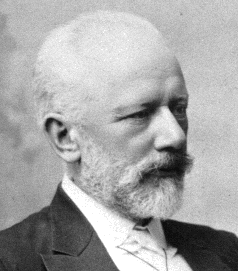
Fyodor Maslov

Russian lawyer and jurist (b. 15/27 July 1840; d. 15/28 March 1915), born Fyodor Ivanovich Maslov (Фёдор Иванович Маслов).
A contemporary of Tchaikovsky's at the Imperial School of Jurisprudence in Saint Petersburg during the 1850s, and a colleague of the composer's at the Ministry of Justice from 1860 to 1861, Fyodor Maslov moved to Moscow with his sisters in 1869. Despite his liberal views, he rose to become chairman of the judicial service for the Moscow region. Maslov was considered an outstanding expert in Russian and European law, and he was also a fine raconteur and amateur poet. Among his other hobbies were music, history, philosophy, genealogy, astronomy, numismatics, photography, book collecting, and travelling. The composer Sergey Taneyev became a very close friend of Maslov, to whose scrutiny he often submitted his works, as well as of Fyodor's sisters Anna, Varvara, and Sofya, and his brother Nikolay (1853-1920). Taneyev spent many happy summers on the Maslovs' estate Selishche, in Oryol province. It was there that he worked on his opera Oresteia from 1882 to 1894, and on his book Convertible Counterpoint in the Strict Style from 1887 to 1906. Lev Tolstoy's wife, the countess Sofya Andreyevna, was another frequent guest at Selishche in the 1890s, and her husband would later borrow books from Fyodor Maslov's extensive library when working on the novel Resurrection (1899) and the story Hadji Murad (1904).
Tchaikovsky was also on friendly terms with the Maslov family, and during his periodical visits to Moscow in later years he would sometimes dine at their house. He was invited to spend the summer with them at Selishche as well, but never got round to doing so.
Memoirs of Tchaikovsky
After the composer's death, Maslov recalled their time together at the Imperial School of Jurisprudence, and later the Ministry of Justice[1].
Pyotr Ilyich was the favorite not only of his classmates, but also of his superiors. No one enjoyed more widespread sympathy than him. Owing to his fine outward appearance, everyone was attracted to him and placed him in the highest regard.
At his arrival in the seventh form, Pyotr Ilyich was particularly friendly with Belyavsky [2], but I soon replaced the latter. In the second half of the seventh and first half of the sixth form we were almost inseparable. In our last year, we were joined by Apukhtin, my fellow townsman [3]. This arrangement continued until the end of 1853, when a conflict occurred. I had been ill for a while and stayed in the infirmary. Upon my return, I was very surprised to see that my deskmate was no longer Tchaikovsky. He was sitting with his new friend Apukhtin. A quarrel ensued. We former friends ceased to talk with one another. Tchaikovsky and I were reconciled in the fifth form before the end of the course, and after that remained friendly our whole lives, but our initial intimacy could no longer be restored. Apukhtin and I were never reconciled.
In the musical relations between students, Pyotr Ilyich, of course, held the primary position, but he did not find in the others a shared interest in his vocation. We were merely amused by the musical tricks he showed us, such as guessing keys and playing the piano with a towel covering the keys. From his earliest days at the school, he was a singer, and for the first three years stood with the second sopranos, for whom he was the precentor. This was necessary because the other sopranos there had weak voices and a poor sense of pitch. Being surrounded by singers who were out of tune caused him considerable distress. Nonetheless, Lomakin[4] always noticed him. In the seventh and sixth forms, Pyotr Ilyich sang the trio "Many years to you, Master" on Catherine's day in the bishop's service. Later in the fifth form, he sang "Let my prayer arise", no longer as a soprano, but as an alto. The regent was always a pupil from the first form. This was because their responsibilities extended beyond music. They were responsible for gathering the students for singing, which required the authority of someone senior in age and position within the school. But in the year 1853/54, there was no sufficiently capable musician in the senior course to become regent, and so the role was assigned to a student of the junior course, Gamaley. In 1856/57, he was replaced by Christanovich (brother of the composer), [in] 1857/58 - Yurenev, and in the autumn of 1858, Tchaikovsky. He remained regent for a limited time, no longer than two months, because he demonstrated neither the ability nor inclination to command. Seletsky, former the assistant, replaced him.
Pyotr Ilyich began smoking very early, although his closest friends were not smokers.
In his everyday life he distinguished himself through his disorganization and negligence. He lent almost the entirety of his father's library to his classmates, even though he himself, using others' books, did not care to return them. In 1869 in Moscow, I found in possession of the conservatory professor – with no connection to jurisprudence whatsoever - a legal work on "embezzlement", still the property of the school, and, amongst others, three copies of Stoyanovsky's manual on criminal procedure.
Pyotr Ilyich was forever without his textbooks and borrowed them from classmates, although his desk was practically communal property - anyone could rummage around it as they pleased. During examinations in the senior course, Pyotr Ilyich and I studied together. We chose the Summer Garden as our place to study, and, so as to not drag along our notes and textbooks, we hid them in the hollow of an old lime tree, covered with slates on top. At the end of exams, I retrieved my notes from there. Pyotr Ilyich constantly forgot to do this, and his schoolwork, perhaps, to this day, is rotting in one of Peter the Great's trees.
Pyotr Ilyich had an interest in literature and took an active role in the journal "School Herald" [5], published in the fifth form by the editors Apukhtin and Ertell. He wrote in the journal a remarkably light and acutely crafted essay on "The Literary History of Our Class" TH 367]] (1854).
In the final years of his school life, Tchaikovsky wrote a diary titled "Everything", where he poured all the secrets of his soul. But he was so trusting and naïve that he kept it not under a lock, but in a general pile on the same desk where he kept his and others' books and notes.
Correspondence with Tchaikovsky
One letter from Tchaikovsky to Fyodor Maslov has survived, dating from 1882, and has been translated into English on this website:
- Letter 2074 – 10/22 August 1882, from Moscow (addressed jointly to Fyodor and to Anna Maslova, Sofya Maslova and Varvara Maslova).
One letter from Maslov to the composer, dating from 19 November/1 December 1887, is preserved in the Tchaikovsky State Memorial Musical Museum-Reserve at Klin (a4, No. 2386).
Bibliography
- П. И. Чайковский. Воспоминания (1962)
- Воспоминания друга (1973)
- Воспоминания друга (1979)
- Воспоминания друга (1980)
- Fyodor Maslov (1993)
- Erinnerungen an meinen Schulfreund Tschaikowsky (1994)
- Fyodor Maslov (1999)
- Slutskaya, T. «Очень хочется в Селище...» (Танеев и семья Масловых) in Fetisova, Ye. V. (ed.). Новое о Танееве (Moscow, 2007), p. 57–69.
Notes and References
- ↑ First published in Жизнь Петра Ильича Чайковского, том 1 (1900), p. 97–98. The English translation presented here is by Emily Liao.
- ↑ Fyodor Fyodorovich Belyavsky (1839–1870), Tchaikovsky's fellow student at the School of Jurisprudence from 1852 to 1856.
- ↑ Maslov's Selishche estate was situated not far from Aleksey Apukhtin's estate at Rybnitsa.
- ↑ Gavriil Yakimovich Lomakin (1812–1885), director of the choir at the Imperial School of Jurisprudence, and co-founder of the Free Music School in Saint Petersburg with Mily Balakirev. The student choir sang during services in the school chapel.
- ↑ Modest Tchaikovsky recalled that "Copies [of the "School Herald"] were preserved throughout the years by Apukhtin. Shortly before his death, he recalled this to V. N. Gerard. Unfortunately, however, all attempts by the latter to search for them among the papers of the deceased poet remained unsuccessful" (see Жизнь Петра Ильича Чайковского, том 1 (1900), p. 96).