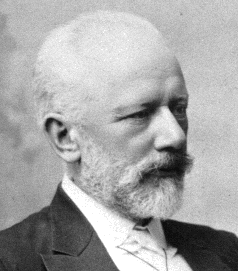
Letter 1987
| Date | 7/19 March 1882 |
|---|---|
| Addressed to | Nadezhda von Meck |
| Where written | Naples |
| Language | Russian |
| Autograph Location | Klin (Russia): Tchaikovsky State Memorial Musical Museum-Reserve (a3, No. 776) |
| Publication | Жизнь Петра Ильича Чайковского, том 2 (1901), p. 524–526 (abridged) П. И. Чайковский. Переписка с Н. Ф. фон-Мекк, том 3 (1936), p. 39–41 П. И. Чайковский. Полное собрание сочинений, том XI (1966), p. 85–87 |
Text and Translation
| Russian text (original) |
English translation By Brett Langston |
Неаполь 7/19 марта 1882 Дорогой, милый друг! Доживаю теперь последние неапольские дни. В среду или четверг мы предполагаем съездить на Капри, оттуда в Сорренто на 2 дня, через Castellamare вернуться и тотчас же уехать во Флоренцию. Сегодня я окончил совершенно свою музыку к Всенощному бдению, которую начинал было ещё летом, потом оставил и только здесь снова за неё взялся. Очень трудно работать в Неаполе. Не говоря уже о том, что красоты Неаполя рассеивают, отрывают от дела, есть ещё одно обстоятельство, препятствующее заниматься, — это несмолкаемые ни на минуту шарманки, которые иногда доводят меня до отчаяния. Случается, что их две, даже три разом играют, да ещё где-нибудь поют, а там невдалеке берсальеры шагистикой занимаются и трубят неустанно от 8 ч[асов] утра до 12. Однако ж, несмотря на всё это, мне так хотелось поскорей окончить начатую работу, что в последние дни я занимался очень усердно и успел совершенно окончить свой труд. В свободные от занятий и прогулок часы я прочёл очень интересную недавно вышедшую книгу о Bellini. Книга эта написана его другом, восьмидесятилетним старцем Florimо Я всегда питал большую симпатию к Беллини. Ещё ребёнком я плакал от силы чувства, которое возбуждали во мне изящные, всегда проникнутые меланхолией мелодии его. И до сих пор, несмотря на многие его недостатки, на плоские его аккомпанементы, на площадные, банальные стретты его ансамблей, на грубость и пошлость речитативов, — у меня сохранилась симпатия к его музыке. О жизни его, кроме того, что умер он рано и был чувствительным, добрым человеком, — я ничего не знал. В книге Florimо, кроме биографии Беллини, напечатана и его довольно обширная переписка. И вот я принялся читать с большим удовольствием описание жизни композитора, с давних пор окружённого в моем воображении ореолом Какой-то особенной поэтичности. Мне казалось, что Веllini должен был быть в жизни таким же детски-благодушным существом, каким был Моцарт. Увы! Пришлось вытерпеть разочарование. Оказывается, что, несмотря на всю свою талантливость, Беллини был очень дюжинная личность. Он весь поглощён в самообожание, восхищается каждым своим тактом, не переносит совершенно никаких осуждений своей музыки, повсюду видит врагов, интриганов и завистников, хотя успех не покидал его ни на один почти день от самого начала его карьеры до самого конца. Судя по письмам, он никого не любил, ни о ком никогда не заботился, и вообще для него вне того, что касалось его интересов, как бы ничего не существовало. Замечательно, что автор книги, по-видимому, вовсе и не заметил, какое неблагоприятное чувство к Беллини возбуждают его письма, — иначе он бы не напечатал их. Другая книга, которую я читаю с величайшим удовольствием, — это «На горах», Мельникова. Какое удивительное знание быта русского и какое спокойное, объективное отношение у автора к огромному количеству изображаемых им лиц! Раскольники разных сект, купцы, мужики, монахи и монахини, дворяне, — все эти люди, как живые, проходят перед читателем, и каждый говорит и делает не то, что автор им навязывает, дабы оттенить и выразить собственный взгляд и убеждения, а то, что действительно эти люди должны говорить и делать. В наше время такая редкость подобные нетенденциозные произведения! 10 час[ов] веч[ера] Всё более и более знакомясь с Неаполем, я прихожу к заключению, что, несмотря на всю его красоту, долго жить в нем неудобно, и не только потому, что так много шума, но также и потому, что все прогулки требуют нескольких часов. Здесь нельзя, как в Риме, бродить по городу и вне города. На этой неделе мы не совершили никакой большой поездки, и когда приходилось ради моциона ходить, то я затруднялся, куда направить стопы свои. По городу ходить — беспокойно, а за город, кроме Pоsilippо (которое после истории с Postiglione мне неприятно), идти решительно некуда. Ещё что отравляет здешние прогулки, — это нищие, которые не только пристают, но показывают свои раны и уродства, — а это для меня очень тяжёлое и неприятное впечатление. Но зато сидеть у окна, у себя, и смотреть на море, на Везувий, особенно рано утром и перед закатом солнца, — это такое блаженство, ради которого все недостатки Неаполя, как города, можно простить и позабыть. В театрах здесь ничего интересного нет. На днях возобновили давно забытую оперу Mercadante «Оraziiе Сuriazii», и газеты с шумом и треском заговорили об этом возобновлении, как о какой-то новой эре в искусстве. Соблазнённый газетными отзывами, я пошёл в S[an] Cаrlо. И что ж оказалось? Этот удивительнейший и притом, судя по газетам, превосходно исполненный chef-d'oeuvre не что иное, как самая пошлая и рутинная итальянская опера, в сравнении с которой «Травиата» и «Трубадур» — великие произведения! Исполнение ниже всякой посредственности. Дорогая моя! Желаю Вам от всей души наслаждаться весной, которая во Флоренции должна быть восхитительна. Будьте здоровы! Безмерно Вас любящий, П. Чайковский Р. S. Видели ли Вы Сарру Бернар? |
Naples 7/19 March 1882 Good, dear friend! I am now spending my last few days in Naples. On Wednesday or Thursday we intend to go to Capri, then on to Sorrento for 2 days, returning via Castellamare, and then immediately set off for Florence. Today I completely finished my music for the All-Night Vigil, which I started in the summer, then abandoned, before only taking it up again here. It is very difficult to work in Naples. Not only because the beauty of Naples beauty distracts me, interrupting my work, but there is another obstacle that hinders my activities — the incessant barrel organ music, which sometimes drives me to despair. It is not uncommon to have two, or even three of them playing simultaneously, with some singing also going on somewhere, while nearby the bersaglieri are busy marching and trumpeting tirelessly from 8 o'clock in the morning until 12. However, despite all this, I was so keen to finish the work I had already begun as quickly as possible, that for the last few days I worked very hard and managed to completely finish my task. In my free time between working and walks, I read a most interesting book published recently about Bellini. The book was written by his friend, the octogenarian Florimo. Even as a child I wept from the intensity of feeling that his graceful, eternally melancholic melodies aroused in me. And to this day, despite his many shortcomings, his uninspired accompaniments, the vulgar, banal stretti of his ensembles, the roughness and vulgarity of his recitatives — I have retained a sympathy for his music. I knew nothing about his life, other that he died early, and he was a kind, sensitive person. Besides Bellini's biography, Florimo's book includes his quite extensive correspondence. And so I began to read with great pleasure the description of the life of a composer who in my imagination had long been surrounded by an aura of some particularly poetic quality. It seemed to me that Bellini must have been as childishly good-natured a creature in life as Mozart had been. Alas! I had to endure disappointment. It turns out that, notwithstanding all his talent, Bellin was a most commonplace individual. He was wholly absorbed in self-adoration, worshipping his every bar, he could absolutely not stand any condemnation of his music, seeing enemies, intriguers and envious people everywhere, even though success did not desert him for even a single day from the very start of his career until the very end. Judging from his letters, he loved no one, never cared for anyone, and generally, it was as if nothing existed outside that which concerned his own interests. It is remarkable that the author of the book appears not to have noticed at all what an unfavourable impressions Bellini's letters would arouse towards him, otherwise he would not have published them. Another book I am reading with the greatest of pleasure is Melnikov's "On the Mountains". What a remarkable knowledge of Russian life, and what a calm, objective approach the author takes to the vast number of characters he portrays! Raskolniks of various sects, merchants, peasants, monks and nun, nobles, — all of these people, large as life, pass before the reader, each saying and doing not what the author imposes upon them in order to shade and express his own views and convictions, but rather what these people should actually say and do. Such untendentious works are so rare in our time! 10 o'clock, evening As I become more and more acquainted with Naples, I am coming to the conclusion that, despite all its beauty, it is inconvenient to live there for long — not only because there is so much noise, but also because all the walks take several hours. Here, as in Rome, you cannot wander around the city or beyond. We have not accomplished any long journeys this week, and when we had to walk for the sake of exercise, I was at a loss as to where to direct my steps. Walking around the city is nerve-racking, and outside the city, besides Pоsilippо (which after the incident with the Postiglione is unpleasant for me) there is absolutely nowhere to go. Another thing spoiling the walks are the local beggars, who not only pester you, but also show off their wounds and deformities, which I find very difficult and unpleasant. But then to sit at home by the window, and to look out at the sea, at Vesuvius, particularly early in the morning and before sunset, is such bliss that all the shortcomings of Naples as a city can be forgiven and forgotten. There is nothing of interest in the theatres here. The other day they revived the long-forgotten opera "Оraziiе Сuriazii" by Mercadente, and the newspapers started discussing it with great fanfare, as if this were some sort of new era in art. Enticed by the newspaper reviews, I went to the San Carlo. And what happened? This most astounding and, judging from the newspapers, superbly performed chef d'oeuvre is nothing other than the most trite and commonplace Italian opera, compared to which "Traviata" and "Trovatore" are great works! The performance was beneath mediocrity. My dear! I wish you with all my heart that you are enjoying the spring, which must be delightful in Florence. Keep well! Your boundlessly loving, P. Tchaikovsky P. S. Did you see Sarah Bernhardt? |